Our New Mobile App is Coming Soon!
Interested in trying out our new mobile app for iPhone or Android as soon as it comes out? Subscribe to our email newsletter below to receive an update as soon as we launch.
Follow us!


%201.svg)


July 19, 2026
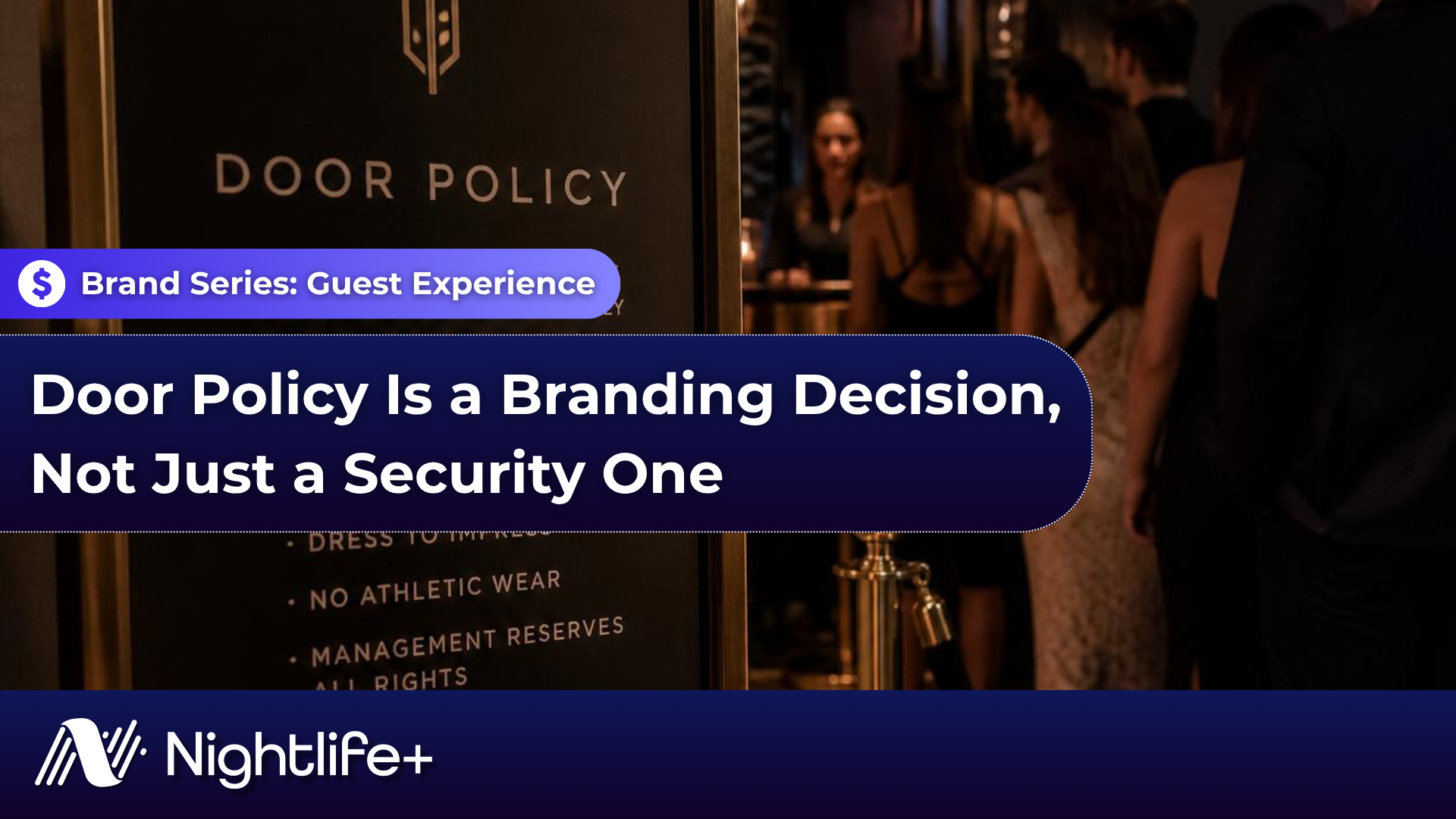
Door Policy Is a Branding Decision, Not Just a Security One
Most venues treat the door as a security function. Keep out trouble, keep the room at capacity, move on to what actually matters inside. But you already know the door is doing more than that. You've seen it. A guest's night can be won or lost in the first 30 seconds, before they've heard a single song. Here's why, and what to do about it.
First impressions form faster than you'd think
Psychologists call it thin-slicing. People form lasting judgments in seconds, based on almost nothing. Tone of voice. Body language. Whether they felt seen or processed.
Your door staff make this judgment for you, whether you've trained them to or not. A guest who feels dismissed at the door will walk into your room already primed to notice what's wrong. A guest who feels welcomed will walk in ready to have a good time; and they'll find reasons to justify that feeling all night.
You're not just managing a line. You're setting the emotional starting point for everyone's night.
The door is where guests decide what kind of place this is
Dress code, wait time, how questions get answered. None of it is neutral. Guests read all of it as information about who you are.
A long wait handled with warmth reads as "in demand, worth it." A long wait handled with silence reads as "they don't care." Same wait time, completely different story in the guest's head.
This is why two venues with identical rules can feel completely different to walk into. The rules aren't the brand. How they're delivered is.
Regulars and first-timers are having two different experiences of the same door
Worth separating these, because they need different things.
Regulars want to feel recognized. Even something small, a name, a nod, a "good to see you," does a lot of work. It tells them the relationship is real, not transactional. That's what turns a customer into someone who brings friends.
First-timers want to feel like they made a good decision by showing up. They're more sensitive to tone than regulars are, because they have nothing to compare it to yet. A cold door confirms their worst fear: that they picked wrong. A warm one settles their nerves before they've even paid for a drink.
If your door staff treat everyone the same way, you're likely underserving both groups.
A firm no is not the same as a bad experience
This one trips venues up. Owners sometimes assume a good door means never turning anyone away. That's not it.
Guests generally accept a no if it's delivered with respect. What they don't accept is feeling small while it happens. The difference is almost entirely tone, not outcome.
Take two versions of the same night. Say a venue hits capacity at 11pm and a group of four shows up hoping to get in.
Version one: the doorman glances over, says "we're full," and looks past them for the next person in line.
Version two: the doorman makes eye contact, says "we're at capacity right now, but if you hang tight until 11:30 I'll get you in myself," and means it.
Same outcome in both cases, the group waits either way. But only one of those groups is telling their friends about this place tomorrow.
Turning someone away well can build more loyalty than letting someone in indifferently.
The door isn't just the entrance. It's often the exit too
There's a well-documented idea in psychology called the peak-end rule. People don't remember an experience as an average of everything that happened. They remember the peak moment and how it ended. That's it. That's the memory.
Most venues pour everything into the peak: the best DJ set, the best table, the best moment on the dance floor. Almost none think about the end, because by the time a guest is leaving, the business part of the night already happened. The bill is paid. The sale is made.
But the guest doesn't know that. They're still forming the memory that decides whether they come back.
A guest who gets an easy exit, a coat handed back without a wait, a doorman saying goodnight and meaning it, a smooth walk to the street, leaves with a rounded-off, positive memory. A guest who gets stuck in a bottleneck on the way out, ignored by the same staff who greeted them warmly hours earlier, leaves with the night's worst moment as its final one. That's the version that sticks.
The door works both directions. Worth designing it that way.
What this means for how you run your door
A few practical shifts, if any of this is landing:
Train door staff on tone, not just rules. They should know the "no" script as well as the "yes" script.
Debrief the door the way you'd debrief service. Ask what happened, not just how many people got in.
Watch for guests who loved the room but never mention the entrance. That gap is worth investigating.
Notice if regulars stop feeling special. That's often the earliest sign a great venue is starting to feel like a business.
Pay as much attention to the last five minutes as the first five. Guests remember endings more than they remember middles.
The door isn't a filter you run guests through before the real experience starts. It's the first scene and the last one. Everything in between is just the story you're telling.
What's your door doing right now that your guests never mention, but definitely remember?
Want more guests walking through that door in the first place?
Nightlife+ helps venues get discovered by people actively looking for a night out, and turns that discovery into guestlist signups, table inquiries, and bookings.
List your venue: https://www.nightlifeplus.app/get-your-venue-listed